

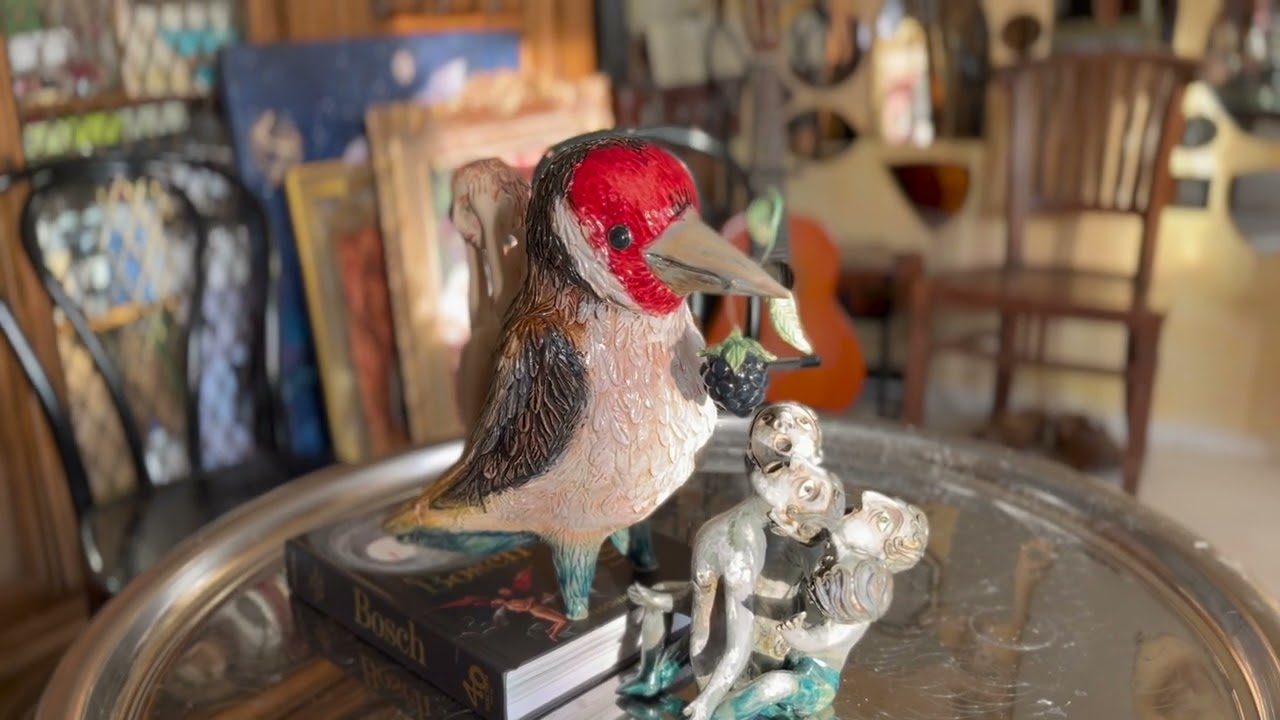
Bosch’s Garden is a feverish theatre of visions: absurd, erotic, grotesque. Yet beneath the delirium lie deeper ideas. Some of his scenes feel almost philosophical, even when they come wrapped in feathers, fruit, and flesh.
As a visual artist, I often begin with form and color, following intuition before meaning arrives. This ceramic scene, drawn from the central panel of Bosch’s triptych, might at first seem to echo familiar themes: sensuality, temptation, the world poised between sin and flood, a lush and surreal anti-Eden.
But once it took shape in three dimensions, something unexpected appeared. A figure perched on the back of a great bird. Pale, bare, wide-eyed. Watching. With hands on his head, he seems overcome, not with ecstasy, but with thought. In a world where everyone else is caught in acts of lust or folly, he appears set apart.
I could not help but think of Max Stirner.
A thinker most people overlook, one whom the great philosophers rarely dare to name. His book Der Einzige und sein Eigentum, written three centuries after Bosch, stands among the most radical rejections of abstraction in modern thought. Stirner gazes into the abyss and refuses to look away.
It is telling that even those most disturbed by his ideas could not bring themselves to utter his name. In The German Ideology, Marx and Engels devote more than three hundred pages to attacking “Saint Max,” mocking and dissecting him, yet never fully confronting him. As if his vision demanded avoidance rather than engagement.
Stirner denied every system, every moral law, every collective ideal. All, he said, are spooks. Only the unique individual, der Einzige, truly exists. Everything else such as God, truth, morality, and history is a fiction trying to claim what cannot be possessed.
Perhaps this is why the figure on the bird feels so compelling. He embodies a paradox. While Stirner’s Unique One declares freedom from all constraint, this figure reveals the cost of that freedom: a kind of existential vertigo. His hands-to-head gesture suggests not just awareness but burden. He has achieved separation from the world, yet sits precariously above it, unable to return. The bird is both his throne and his cage, lifting him even as it isolates him. The sculpture becomes a question in clay: is radical self-ownership liberation, or another form of confinement? The figure sees the world of illusions below and knows he stands apart from them, yet his face betrays no joy in that knowledge. It shows only weight.
His shadow reaches toward Nietzsche and Sartre, flickers in Heidegger’s Dasein, and now, unexpectedly, it flickers here, shaped in clay, inside a Boschian dream.
This seated figure on the bird could he be the Einzige incarnate? While those below are lost in desire, ritual, and hunger, he remains alone, above, separate. Yet what they consume seems to belong to him. His “property” is devoured by shadows, figures born of his own abandoned illusions.
He knows it. He watches. He does not intervene.
Once, in the left panel of Bosch’s Garden, he might have been free. The first human. The original witness. Adam before the naming, before shame, before Eve. Not yet sinner, not yet citizen, not yet man. A true Einzige beside God.
Can he return to that state?
His posture answers with silence.
This work captures the moment when return becomes impossible, when full awareness turns to exile. The individual understands too much and belongs nowhere. Even the bird beneath him is absurd and mythic. Even the fruit recalls loss. And so he sits, not quite tragic, not quite redeemed. Aware. Separate. Alone.
Note, that the store section on this website is reserved exclusively for artists Patreon supporters. By joining, you not only support my art but also gain private access to artworks, limited editions, and behind-the-scenes creations that are not available anywhere else. You are welcome! patreon.com/yalonetski